 Alex Sarnoff
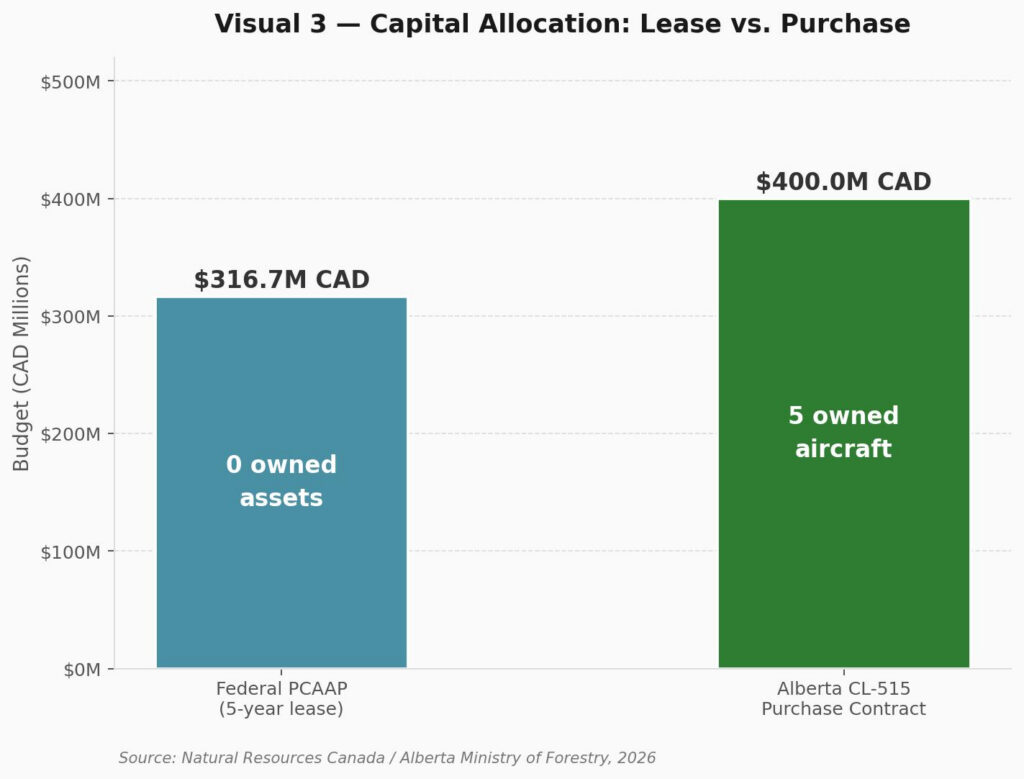
 Ottawa’s $316.7-million Pan-Canadian Aerial Asset Program buys five fire seasons of access and no aircraft. The bill comes due, in more ways than one, on September 27.
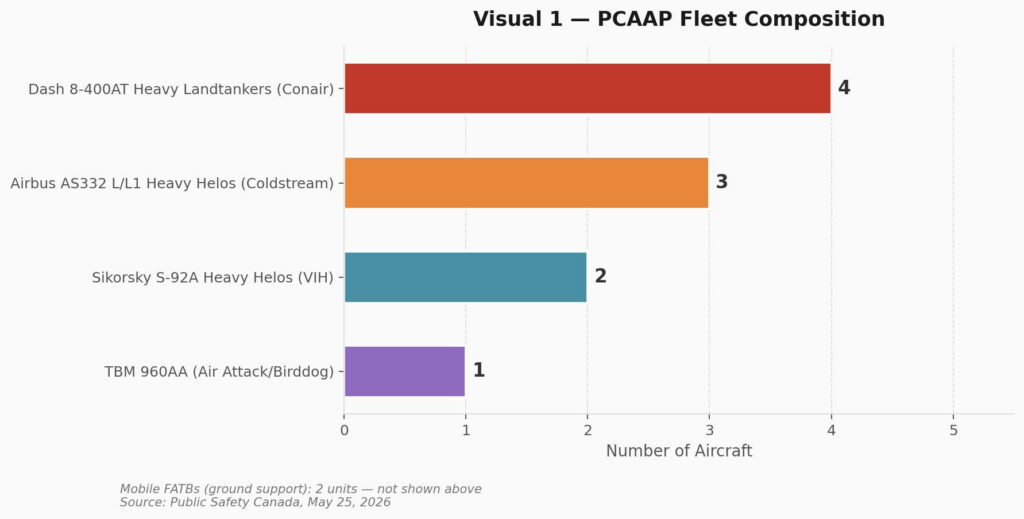
Minister Eleanor Olszewski stepped in front of the cameras in Ottawa on May 25 and told the country it finally had a national aerial firefighting fleet. The Pan-Canadian Aerial Asset Program, ten aircraft and $316.7 million across five years, was billed as a turning point in how Canada fights wildfire. Read the contracts and the turning point looks a great deal like rent.
The money buys access, not aircraft
Every dollar of that budget goes to three private operators in British Columbia, all of them on seasonal leases: Conair, Coldstream Helicopters and VIH Aviation. The Conair and Coldstream aircraft fly from May 1 to September 27 this year; VIH’s helicopters from May 22 to October 18. When those windows close, Ottawa owns nothing. No aircraft, no hangars, no maintenance shops, no obligation to keep a single crew on the payroll. For all practical purposes the program stops flying on September 27 and starts again the following spring.
Over five years the federal government will spend $316.7 million and end up owning not one airplane. Set that beside what Alberta did. In February the province put $400 million toward buying five new De Havilland Canada CL-515 water-scoopers outright. Alberta pays more, pays once, and keeps the fleet. Ottawa pays year after year for access it never converts into anything it holds.
That is a choice, not an accident of budgeting, and it ties the country to the commercial lease market for the long haul. The trouble with the bet is timing. By 2030, when fire seasons in the western United States, southern Europe and Australia are forecast to peak harder and overlap more, Canada will be bidding for the same pool of leasable aircraft as every other government that put off buying. The airframes available at a reasonable rate today won’t be available at any rate when three continents want them in the same July.
The $316.7 million doesn’t build a program. It rents one and calls it a fleet.
Aircraft that can’t reach the fires that matter
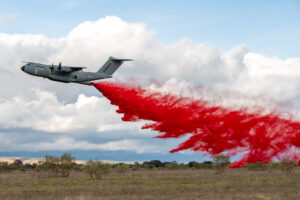
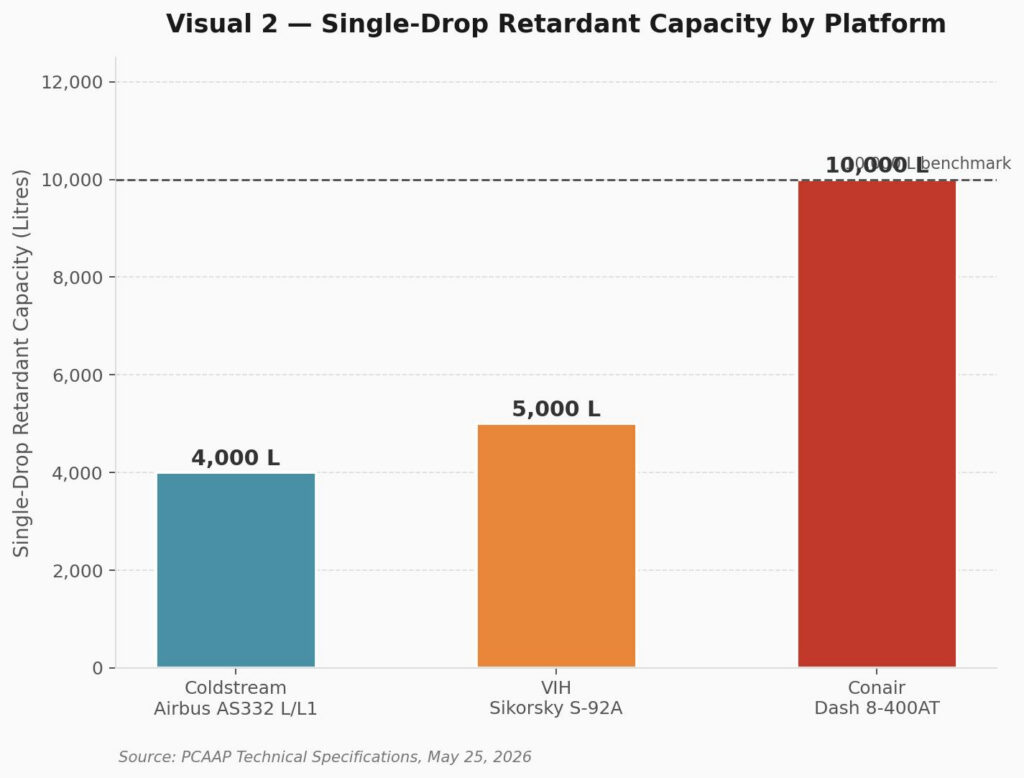
The four Dash 8-400AT tankers are the heart of the program, and on paper they are serious machines: 10,000 litres of retardant a drop, a 600-km/h cruise, fast and modern. The catch is in the fine print of the spec sheet. They need a paved runway of at least 5,000 feet.
Canada’s worst fire country does not come with paved runways. The communities most exposed, the ones in the boreal and sub-boreal belt across northern B.C., Alberta and Saskatchewan, are served by gravel strips, short municipal fields, or nothing built for aircraft at all. A Dash 8-400AT can’t work out of any of them.
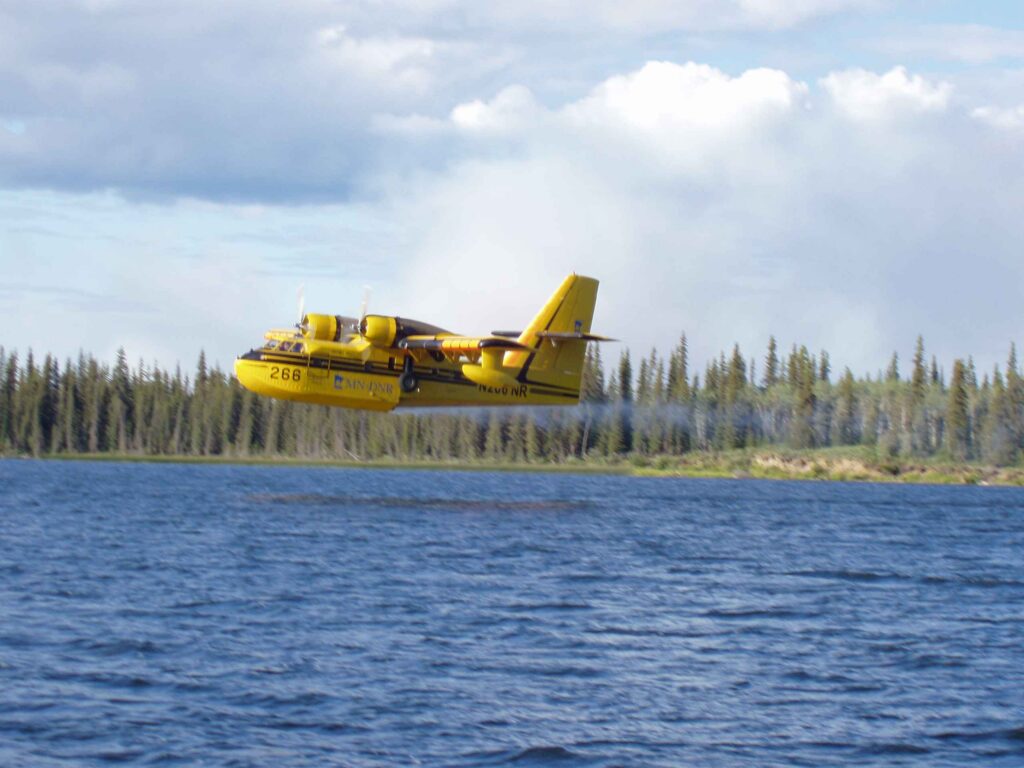
This is the mismatch the announcement skated past. The provinces built their fleets around amphibious aircraft, the CL-215, the CL-415 and now the CL-515, for exactly this reason: they scoop out of lakes and rivers instead of needing a prepared retardant base. The federal tankers need pavement, plus pre-positioned Forward Attack Tanker Bases to fly at all, and the program comes with two of those, both mobile. Two mobile bases for a country of ten million square kilometres is less a fix than an admission of the gap. In a season when several provinces burn at once, which is the very scenario the program is meant to cover, two bases can’t be in four places. The Dash 8s will sit idle not for want of weather or crews but for want of somewhere to land and reload. The 2023 season, when 165,000 square kilometres burned, was exactly that kind of year.
What the federal fleet is built for is fires near decent airports. Those are the fires the provinces can already handle.
A federal fleet with no one in command
The program runs its aircraft through the Canadian Interagency Forest Fire Centre, the Winnipeg body that brokers resource-sharing among the provinces. That is the wrong machinery for a federal asset.
CIFFC was built as a clearinghouse, a way for provinces to lend each other planes and crews when one region runs short. It works by negotiation, not order. When Quebec wants Alberta’s scoopers, CIFFC passes along the request, and Alberta is free to say no. The whole thing rests on goodwill and whatever slack happens to exist that week.
Drop a federal fleet into that arrangement and it inherits the same ceiling. The centre’s executive director, Kelsey Winter, called the program a boost to the country’s “collective ability to move aircraft where it is needed most.” Collective is the operative word. It means the same negotiation that governs every other shared resource. There is no federal override, no one who can simply send the tankers to a chosen province without working the consensus process.
The 2023 season is the tell. Several provinces hit extreme conditions at the same time, which is precisely when a consensus model buckles. Every premier’s fire is the priority. Nobody at CIFFC has the standing to tell Saskatchewan to wait while B.C. takes the federal tankers. Ottawa has bought the aircraft and skipped the command structure that would let it deploy them on its own terms. What it has is a provincial resource pool with a federal logo on it.
The honest defence, and its limit
The government’s best argument is also its most candid. Olszewski’s case was that the point was to get firefighting aircraft in place for this season rather than wait out manufacturing queues that can run past five years.
She’s right about the factory math. De Havilland Canada is turning out CL-515s on a tight schedule, and orders from governments across North America, Europe and Australia have pushed delivery on new contracts past 2030. A federal decision to buy in 2026 wouldn’t put a plane over a fire before 2031. That’s five more seasons with nothing federal in the air. Leasing from operators who already have the aircraft, the pilots and the maintenance behind them is the only way to field anything this year. Fair enough.
But that reasoning only works if the lease is a bridge to ownership rather than the end state. And the five-year program comes with no announced plan to buy, no stated intent to, and no money put toward the domestic manufacturing that might shorten the queue next time. Ottawa has used the supply-chain problem to justify leasing without doing a thing to solve the supply-chain problem. Five years and $316.7 million from now, it walks back into the same market, against the same backlog, owning the same nothing.
Conair’s chief executive, Chris Niemann, put it more grandly on June 1: “For the first time, Canada has its own national fleet.” Coming from a vendor, that’s understandable. It also isn’t true. Canada has a national lease. The distinction will matter in 2030, when the contracts come up for renewal against a demand curve that won’t be doing the buyer any favours.
On September 27 the Conair and Coldstream leases run out. The Dash 8s go back to their owners, and federal firefighting capacity returns to the zero owned aircraft it stood at on May 24. If this year’s fire season runs past that date, the way fire seasons increasingly do, the federal fleet will be grounded by the calendar rather than the weather.
That makes September 27 the date to watch in Canadian fire policy. It will show, plainly, whether the program is a program or a press release. Use the months before it to start a real procurement for owned aircraft and the lease will have done its job as a stopgap. Reach it with nothing on the record, and the first cycle closes the way it opened: about $63 million spent in year one, no aircraft to show for it, and the same argument waiting to be had again next spring.
Sources
- Public Safety Canada / Natural Resources Canada, Pan-Canadian Aerial Asset Program budget and fleet announcement, May 25, 2026.
- Canadian Interagency Forest Fire Centre, PCAAP fleet manifest and procurement data, May 2026.
- Public Safety Canada, PCAAP technical specification report (Dash 8-400AT performance boundaries), May 25, 2026.
- Alberta Ministry of Forestry / Skies Magazine, Alberta CL-515 purchase announcement, February 2026.
- Minister Eleanor Olszewski, press conference statement, May 25, 2026.
- Kelsey Winter, CIFFC executive director, program launch statement, May 2026.
- Chris Niemann, Conair Group Inc., industrial communiqué, June 1, 2026.
- CIFFC, 2023 Canadian wildfire season summary (165,000 km² burned), February 2024.