The Certification Bottleneck: Why Aerial Firefighting’s Greatest Simulation Breakthrough Is Trapped in Regulatory Limbo
 wpadmin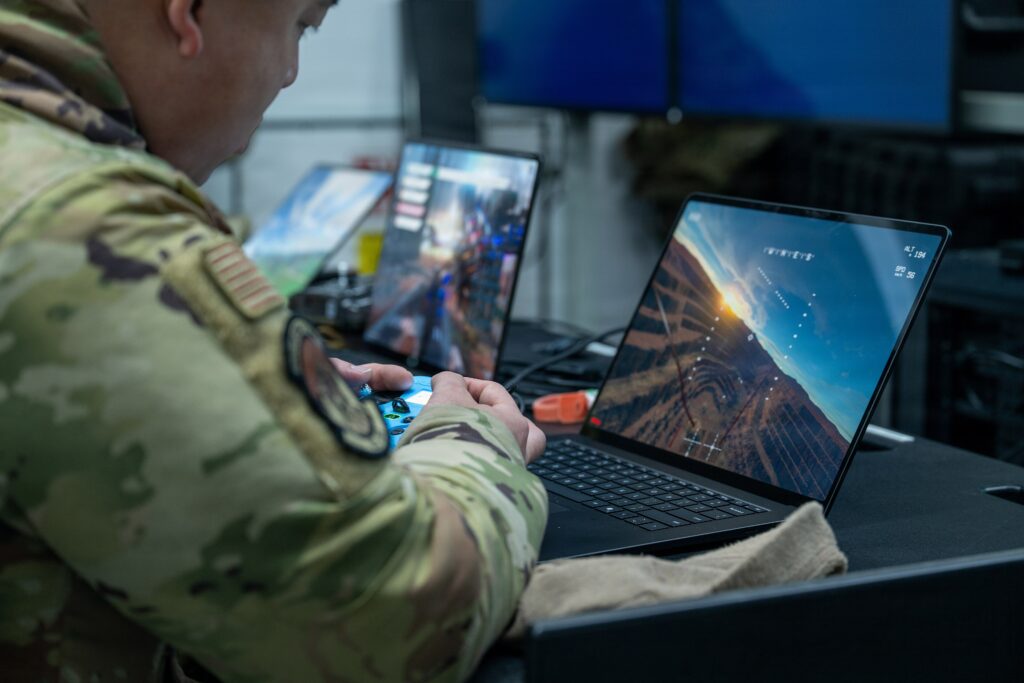
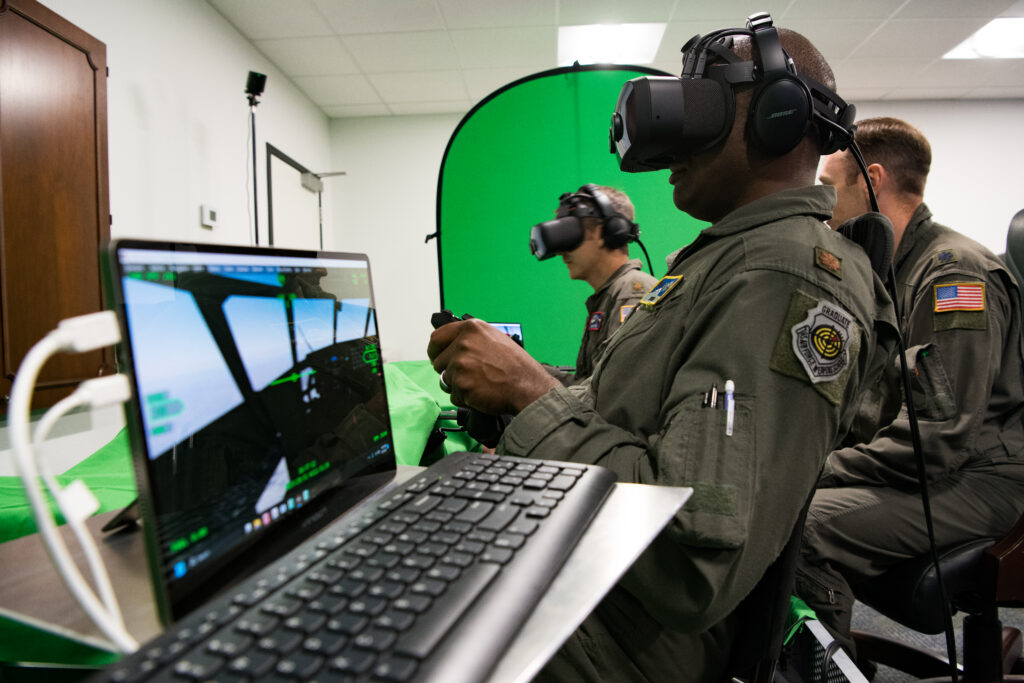
U.S. Air Force Staff Sgt. Yuya Dorgan maneuvers a drone in a virtually simulated environment during the Joint Multi-Domain Counter Unmanned Aircraft Systems Operator Course in the Grafenwoehr Training Area, Germany, Feb. 13, 2026. The Joint Multi-Domain Counter Unmanned Aircraft Systems Operator Course is a course designed to turn warfighters into subject matter experts in counter-UAS tactics who return to their units as force multipliers in countering the UAS threat. (U.S. Army photo by Staff Sgt. Jamie Robinson)
May 2026
The Anomaly at 20 Knots
A simulated helicopter flew toward a fire line at 20 knots. Its rotor wash punched forward, hitting the blaze before the airframe did. The fire expanded. An abrupt thermal plume shot upward. The aircraft’s flight path destabilized within seconds.
No human pilot was harmed. But the lesson was lethal.
This was not a crash investigation. It was a validation test inside the University of Glasgow’s Daedalus I flight simulation framework, published in the CEAS Aeronautical Journal in May 2026. The software’s in-house aerodynamic solver—designated HLBM2—computed the full sequence in real time: rotor downwash altered fire propagation, fire propagation altered the atmosphere, the atmosphere altered the aircraft. Two-way coupling. Sixty frames per second. On a consumer Nvidia RTX 4090 GPU.
Every legacy flight simulator on the market would have missed it entirely. Standard training devices rely on pre-scripted fire environments—static visual textures that do not respond to aircraft wake, do not generate reactive thermal columns, and do not feed aerodynamic consequences back into the flight model. The fire in a conventional simulator is wallpaper. The fire in Daedalus I is physics.
The distinction is not academic. It is the difference between a pilot who has rehearsed a thermal plume entry and a pilot who has never experienced one until a real wildfire delivers it at 200 feet above ground level.
The Mathematical Democratization
The core engineering achievement belongs to Oyedoyin Dada, a postgraduate researcher at Glasgow’s James Watt School of Engineering, working under corresponding author Professor George Barakos, with co-authors Dr. Tao Zhang (Glasgow) and Dr. Lu You (Guizhou University, China). Funding came from the UK Engineering and Physical Sciences Research Council (EPSRC).
Their solver, HLBM2, applies the Lattice Boltzmann Method—a computational fluid dynamics (CFD) approach that models fluid behavior as particle distributions on a discrete lattice grid rather than solving continuous Navier-Stokes equations directly. The method parallelizes efficiently across GPU architectures, which is precisely why it runs on a $1,599 graphics card instead of a multimillion-dollar supercomputing cluster.
Dada stated plainly: “Supercomputers are capable of simulating fluid behavior, but it’s not practical to use that level of power in flight simulators. What is urgently needed instead is more accessible simulations which harness the power of GPU processors to model the interactions between the plume coming from the fire and the wake of the aircraft.”
The processing numbers confirm the claim. Traditional supercomputing CFD renders a single frame of coupled atmospheric-to-fire interaction in hours or days. HLBM2 processes the entire loop—fire spread, smoke plume dynamics, wind vector modification, aircraft wake interaction, and updated flight handling qualities—in under 16.6 milliseconds. That speed synchronizes natively with hydraulic motion platforms. Below 60 FPS, pilots experience visual-vestibular mismatch. Above it, the cockpit feels real.
Professor Barakos reinforced the operational threshold: “Our software performs fast enough to calculate the fluid dynamic interactions at 60 frames or more per second, a refresh rate fast enough to enable seamless communication between the simulation components and the motion platform housing the pilot… These kinds of interactions are not possible in traditional simulation systems, which rely on precomputed conditions.”
The research team has announced its next phase: recruiting experienced aerial firefighting pilots for pilot-in-the-loop testing, scheduled to begin over summer 2026.
The Regulatory Dead-Zone
Here is where the celebration stops.
The FAA’s National Simulator Program governs how flight simulators earn legal qualification to credit pilots with authorized training hours. The certification ladder—from Flight Training Device (FTD) Level 4 through Full Flight Simulator (FFS) Level D—demands that every software component produce deterministic, repeatable outputs. The same input conditions must generate the same output conditions, every time, across every evaluation cycle. This is not a preference. It is a legal requirement.
Daedalus I violates that requirement by design. The HLBM2 solver is a real-time computational engine. Its outputs are non-deterministic. Run the same fire scenario twice, and micro-level variations in the Lattice Boltzmann particle distributions will produce subtly different thermal plumes, subtly different wake interactions, subtly different aircraft responses. That is what makes it realistic. It is also what makes it uncertifiable under current rules.
The regulatory deficit extends further. In January 2026, the FAA’s Office of Aerospace Medicine published Report No. DOT/FAA/AM-26/01, documenting the absence of codified evaluation criteria for training pilots on advanced synthetic vision systems and head-worn flight simulation tracking architectures. The report did not propose new standards. It cataloged the void. The FAA currently has no legal framework to evaluate the class of immersive, GPU-driven, physics-responsive simulation that Daedalus I represents.
Meanwhile, the commercial sector continues certifying hardware that regulators can evaluate. In March 2026, Aquarius Aerial Firefighting deployed an Entrol-developed AT-802 Fire Boss simulator targeting FTD Level 2 certification at its new European training facility. The device uses physical glass cockpits and head-up displays. Its computing environment is locked down, deterministic, and pre-calculated. It passes certification because it was built to pass certification—not because it replicates the physics of a convective wildfire column.
The Cost and the C-130
The U.S. military understands simulation’s fiscal arithmetic. In January 2023, the Department of Defense broke ground on a Weapons System Trainer Reconfigurable C-130J (WST 12R) facility at Channel Islands Air National Guard Station in California—the first military simulator to integrate a dedicated MAFFS (Modular Airborne Fire Fighting System) training profile. The 146th Airlift Wing projected $6.3 million in annual savings by migrating regional crews from live fuel-burn maneuvers into centralized ground-based training.
That $6.3 million figure is real. It captures reduced jet fuel consumption, lower multi-unit cross-country travel costs, and decreased airframe fatigue lifecycle hours across the C-130J fleet. The simulator is now operational.
But the WST 12R runs locked-down, pre-calculated mission profiles. Its MAFFS training module does not compute real-time fire-atmosphere-aircraft coupling. It teaches procedures. It teaches cockpit management. It does not teach a pilot what happens when a C-130’s prop wash accelerates a crown fire directly beneath the aircraft at 150 feet AGL.
Regulators and legacy operators will defend this architecture. Their argument is coherent: uncoupled, deterministic simulators are adequate for current training requirements. Introducing chaotic, real-time CFD into the certification loop adds un-certifiable randomness that degrades standardized, repeatable pilot evaluation metrics. They point to the annual April MAFFS recertification field flights—live, multi-agency water-drop maneuvers conducted over controlled terrain—as proof that the existing system works. Pilots who pass those flights are cleared for the fire season.
The counterargument is narrower but sharper. Those April flights expose pilots to real atmospheric conditions, but they cannot replicate the specific, catastrophic thermal plume entries that kill crews. You cannot schedule a crown fire for a training exercise. You cannot ask a convective column to arrive on a Tuesday in Colorado. The Glasgow test at 20 knots demonstrated an interaction that no pilot in the current pipeline will ever rehearse—until one encounters it for the first time over a live blaze.
The Perilous Summer
Summer 2026 is approaching. Western fire seasons have grown longer, hotter, and more convectively violent. The Glasgow team will begin strapping experienced pilots into motion platforms to validate their software against human performance data. If those tests succeed, the Daedalus I framework will represent the most significant leap in aerial firefighting simulation fidelity in decades.
And it will sit in a university lab.
No FAA advisory circular addresses non-deterministic fluid solvers on consumer GPUs. No EASA certification standard contemplates open-source aerodynamic engines producing variable outputs across identical test runs. The legal architecture governing simulator qualification was written for a world of pre-baked environments and locked-down hardware. It has no vocabulary for real-time physics.
The engineering is solved. Oyedoyin Dada and George Barakos proved that a $1,599 graphics card can do what a supercomputer does, fast enough to train a pilot. The regulatory framework has not moved. The FAA’s own January 2026 report confirms it has not even begun to draft the evaluation criteria that would allow it to move.
The tragedy ahead is specific. Pilots will fly into convective wildfire columns this summer without ever having trained for the aerodynamic interactions those columns produce. The software to train them exists. The legal authority to certify that software does not. The bottleneck is not computation. It is certification. And certification, as currently constructed, is frozen.
Sources
- University of Glasgow News — “Simulation breakthrough could spark aerial firefighter training revolution.” May 11, 2026. https://www.gla.ac.uk/news/headline_1265061_en.html
- AirMed&Rescue — “Simulation breakthrough could transform aerial firefighting pilot training, researchers say.” May 14, 2026. https://www.airmedandrescue.com/latest/news/simulation-breakthrough-could-transform-aerial-firefighting-pilot-training-researchers
- Aerospace Testing International — “Simulation software models aerial firefighting dynamics in real time.” May 11, 2026. https://www.aerospacetestinginternational.com/news/simulation-software-models-aerial-firefighting-dynamics-in-real-time.html
- National Guard Bureau News — “Hollywood Guard Hosts Groundbreaking for C-130J Simulator.” January 6, 2023. https://www.nationalguard.mil/News/Article-View/Article/3260615/hollywood-guard-hosts-groundbreaking-for-c-130j-simulator/
- AirMed&Rescue — “Aquarius Aerial Firefighting opens new simulation and training facility.” March 25, 2026. https://www.airmedandrescue.com/latest/news/aquarius-aerial-firefighting-opens-new-simulation-and-training-facility
- FAA Office of Aerospace Medicine — “Operational and Human Factors Considerations for Synthetic Vision Systems and Head-worn Displays.” Report No. DOT/FAA/AM-26/01, January 2026. https://www.faa.gov/data_research/research/med_humanfacs/oamtechreports/media/202601.pdf