 wpadmin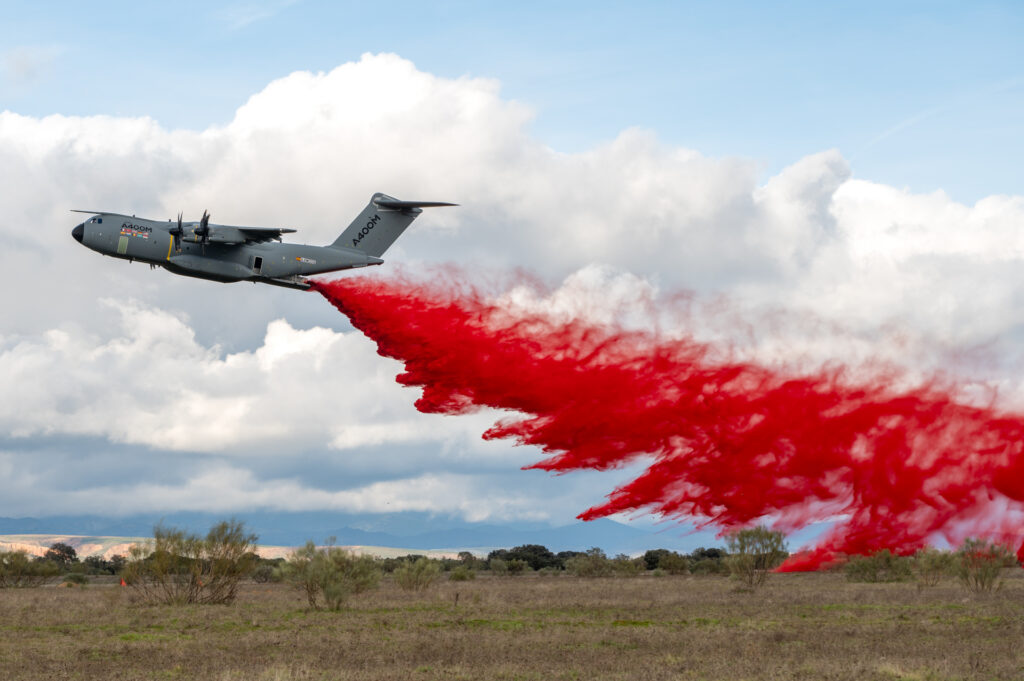
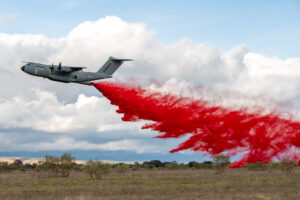
BORDEAUX, France — When a French Air and Space Force A400M released some 20,000 liters of retardant ahead of a fire front in the Gironde on July 25, it marked the type’s first operational firefighting drop — and the end of an unusually fast experiment. Fifteen days earlier, the French government had signed a convention with Airbus to fit a single A400M with a roll-on firefighting kit on a trial basis. The fire season did not wait for the trial to finish.
It has been that kind of summer. In mid-July, fire burned roughly 800 hectares of the Fontainebleau forest an hour outside Paris, forcing the evacuation of some 900 homes while tankers transited from their Mediterranean bases — positioned, as they have been for decades, for the fires that historically menace Provence and Corsica, not the Île-de-France. Across France and Spain, evacuations exceeded 200,000 people as Europe tracked toward record wildfire totals, and Avincis, the continent’s largest aerial emergency services operator, warned publicly that Europe’s waterbomber capacity was under strain.

What Europe is reaching for in response is not really a new aircraft. It is a concept: a modular tank that rolls into a military transport, turns it into an airtanker for the season, and rolls back out when the mission ends — no permanent modification, no dedicated airframe sitting idle eleven months a year. The United States has been flying that playbook since the 1970s. It is called MAFFS.
A playbook written in 1971
The Modular Airborne FireFighting System was prototyped by FMC Corporation in 1971 and built by Aero Union, and it established the doctrine Europe is now discovering: when the commercial airtanker fleet is fully committed, military transports become surge tankers. Today the U.S. Forest Service owns eight of the second-generation MAFFS II units, flown by Air National Guard and Air Force Reserve C-130 wings in California, Nevada, Wyoming, and Colorado. The system installs in a C-130 in about an hour with no structural modification, and activation runs through a mature interagency machinery — trained crews, annual certification, and a standing agreement that makes the capability available within 24 hours.
That institutional depth is the part that does not show up on a spec sheet. Europe is now building, more or less from scratch, what the MAFFS program has spent five decades refining: the crews, the training pipeline, and the civil-military activation rules that turn a transport squadron into a firefighting force on short notice.
Gravity or pressure: two ways to drop ten tons
The A400M kit and MAFFS II represent two different answers to the same engineering question. The Airbus kit is gravity-fed: a cargo-bay tank releases up to 20,000 liters through the open rear ramp in under ten seconds. It is a deliberately simple design — Airbus engineers have said they rejected a pressurized approach because it imposes higher structural loads, and the gravity drop handles like a routine cargo airdrop. In French and Spanish trials the system laid dense retardant lines more than 400 meters long, and the Gironde mission used exactly that profile: indirect attack, building containment line ahead of the fire.
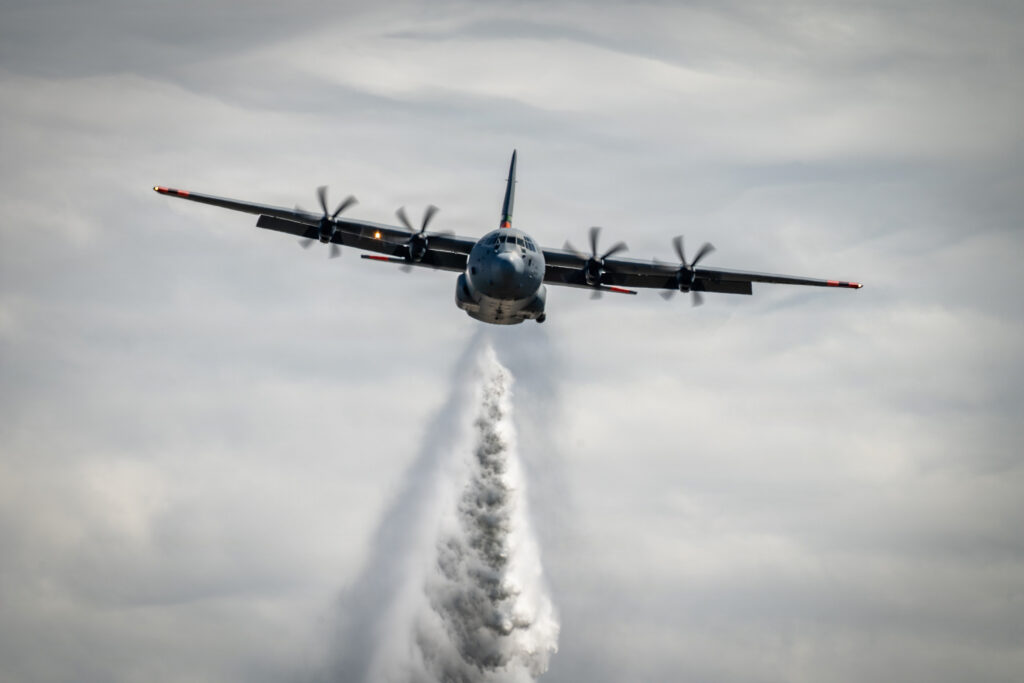
MAFFS II takes the opposite approach. Compressed air forces retardant out through a nozzle at a controlled, metered rate, which is what lets crews match any U.S. Forest Service coverage level from 1 through 8 — calibrating the density of retardant on the ground to the fuels, terrain, and fire intensity below. Because the flow is pressurized rather than gravity-driven, a single 11,350-liter load can also be split into multiple partial drops on separate targets, and onboard compressors repressurize the system in flight, so the aircraft can reload and return without waiting on ground equipment.

Each philosophy has its moment. When the assignment is one long, heavy line laid in a single pass — mass on target, all at once — a gravity salvo is a blunt and effective instrument. But wildfires rarely cooperate with a single-drop plan. When an incident commander needs a lighter coverage level on grass and a heavier one on timber, or wants one aircraft to service three hot spots on one load, or needs the drop feathered along a ridgeline, metered pressurized flow is doing work a gravity door cannot. Reload times are comparable — roughly eight to twelve minutes for MAFFS II, about ten for the A400M kit — so the difference on a fire is less about tempo than about control.
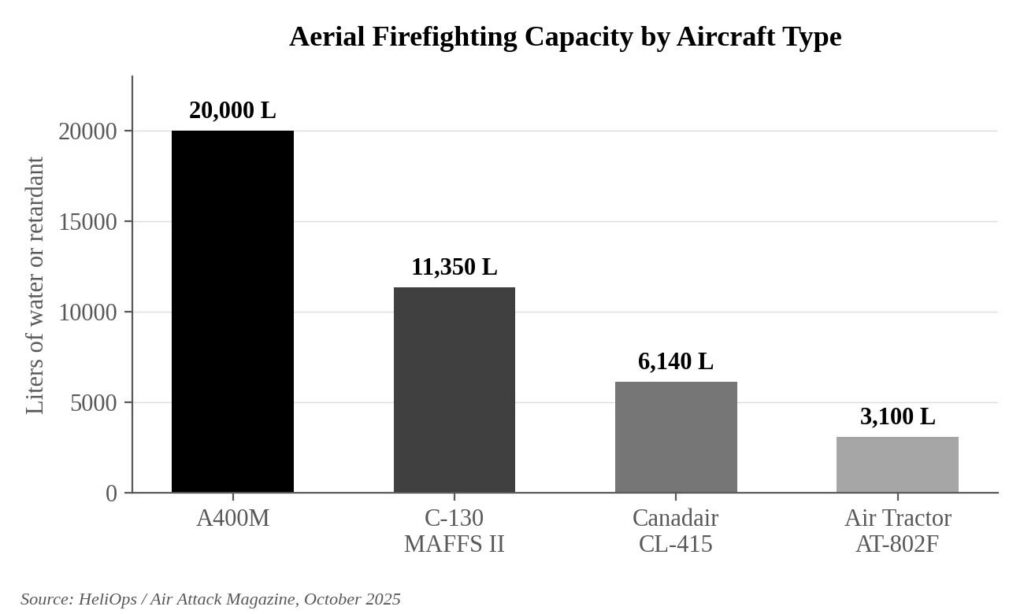
Figure 1. Payload comparison across current aerial firefighting platforms.
A lesson already written on the airframe
There is also a piece of history worth knowing here, because the U.S. program has already flown the architecture Europe is now adopting. The original MAFFS I discharged retardant through tubes extended out the open rear cargo ramp — which meant the aircraft flew the drop unpressurized, took a drag penalty with the ramp open, and routinely came home with its tail bathed in corrosive retardant blowback. Crews and maintainers lived with those trade-offs for three decades.
MAFFS II, which flew its first fire in 2008, was engineered specifically to retire them. Discharge moved to a sealed nozzle plug in the left paratroop door, so every door stays closed and the aircraft remains pressurized throughout the drop — no blowback over the airframe, no drag penalty, and no exposure of the crew or the empennage to the retardant stream.
The A400M kit discharges through the open rear ramp — the same basic architecture MAFFS started with. Airbus is candid that this was a deliberate design choice in favor of simplicity and lower structural loads, and nothing about the Gironde drop suggests it kept the aircraft from doing its job. But it is factual context worth having: the open-ramp era is one the American program went through, learned from, and engineered its way out of.
The price of volume
The A400M’s headline advantage is capacity — 20,000 liters against MAFFS II’s 11,350. The rest of the ledger runs the other way. French budget documents have put the A400M’s unit cost at roughly €152 million, or about $200 million once development is amortized, while a new C-130J runs roughly $62–68 million flyaway — and the used C-130H market is cheaper still, a path Coulson Aviation took in 2025 when it bought four retired New Zealand Hercules for tanker conversion. Published operating estimates tell a similar story: on the order of $30,000 per flight hour for the A400M against roughly $6,000–9,000 for a C-130.

Run the math and the volume advantage inverts. For the acquisition cost of one A400M, a government can field two to three MAFFS-capable C-130s — more tails, dispersed basing, and coverage of simultaneous fires — and every hour those aircraft spend over a fire line costs a fraction as much. That arithmetic matters most in exactly the argument now playing out inside European procurement offices: an A400M pulled from air force duty accrues flight hours against military training and readiness budgets, and a firefighting hour that costs $30,000 is a harder sell as a routine seasonal commitment than one costing a fifth of that.

Figure 2. Published acquisition and operating cost estimates, A400M vs. C-130.
Europe’s catch-up — and the multi-airframe card
Underneath the hardware story is a doctrinal one. European aerial firefighting has long been built around amphibious scoopers and rotary assets — 79 Type-II amphibians like the Canadair CL-415 are available among EU member states, with 22 new DHC-515s on order — and long-term retardant has historically been viewed with skepticism. France’s own civil protection directorate was initially doubtful of the A400M concept and came around only after the 2024–2025 retardant trials. The Gironde mission, a pure retardant indirect-attack sortie, is the clearest sign yet that the doctrine is shifting: Europe increasingly wants surge capacity that lays chemical line, not just water.
The A400M is one tool for that job. But the roll-on, roll-off concept is not tied to one airframe, and this is where the American system’s head start compounds. MAFFS II has flown on C-130H and J models for decades — aircraft operated across NATO air forces. It is operational on the Embraer C-390: the Brazilian Air Force flew the system on more than 100 firefighting missions in 2024, delivering over a million liters, and Portugal — a C-390 customer — ordered two MAFFS II units in 2025. And Leonardo has integrated a modified MAFFS II on the C-27J Spartan, with drop tests in mid-2024, an operational demonstration that November, and Slovenian service planned from the 2025 season, while Bulgaria, Greece, Romania, and Morocco study the same fit.
Those are, overwhelmingly, airplanes Europe already owns. A kit family that spans the C-130H/J, C-390, and C-27J lets a country turn the transport fleet it has into the tanker fleet it needs — without buying a $200 million airlifter to get there.
What comes next
None of this argues against the A400M over a fire. On the worst days of a season like this one, every credible heavy asset will be needed, and France’s willingness to push a trial kit into operational service in fifteen days is to its credit. But the quieter, more durable shift is not any single aircraft — it is Europe’s embrace of modular, retardant-capable surge airpower itself. That idea has a fifty-year service record, a sealed pressurized drop system that solved problems Europe’s new kit is just beginning to meet, and a compatibility list that already covers the airframes sitting on European ramps. Europe is not early to roll-on aerial firefighting. It is catching up — and the fastest way to catch up is rarely to start over.