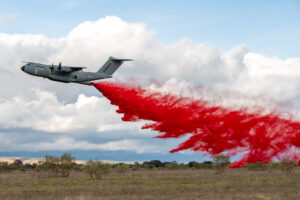
 wpadmin
Why the Aerial Firefighting Fleet is Flight-Pathing to the Airbus A319
On the night of June 20, 2026, a fire broke out in the Salt Lake City foothills above the University of Utah. By morning the Bonneville Fire had crept close enough to threaten the campus medical research complexes, and dispatchers scrambled a heavy tanker for low runs over a hospital district. An Erickson Aero Tanker made the drops, working the line with helicopters in terrain that left no room for a missed pass, according to KSL.com. The jet that answered was already old. The jet meant to replace it had landed in Alabama four days earlier, and it won’t fly a fire season for at least eighteen more months.

That gap is the real story behind Neptune Aviation’s move to the Airbus A319, and it has almost nothing to do with better avionics.
On June 24, Neptune took delivery of its first ex-commercial A319-100 at a 400,000-square-foot facility in Dothan, Alabama, run by Commercial Jet, where the plane will spend the next year and a half getting cut open, reinforced, and rebuilt as an airtanker. Nic Lynn, the company’s vice president of operations, described the milestone bluntly on delivery day: “The upgrade of our airtanker fleet is fully underway. We have a physical aircraft available that we can convert for aerial firefighting. Our team can start performing test flights, and we can start zeroing in on completing the modifications that must be made to have the aircraftready for 2028.”
Eighteen months ago, trade coverage was still projecting a 2027 entry into service, an estimate built on engineering simulations before Neptune had an actual airframe. Once the plane arrived and Commercial Jet’s crews started scoping the real conversion, the timeline slipped a full year. That’s what happens when a company stops planning a fleet transition on paper and starts running into the condition of the aircraft it actually flies.
That condition is the part nobody in the trade press says plainly. Neptune’s BAe 146 fleet, the backbone of large-airtanker firefighting for two decades, is running out of parts. The quad-jet stopped production in 2001. Industry fleet assessments from June describe structural part scarcity, thinning airframe availability, and vanishing logistics channels for the type. Nobody is building new wing spars for a plane that hasn’t rolled off a line in 25 years, and the pool of retired airframes left to strip for parts keeps shrinking as operators worldwide draw from it. Neptune isn’t picking the A319 the way an airline shops for a lower fuel bill. It’s grabbing the only lifeboat still afloat.

The performance gains are real, to be fair. The converted A319 carries a minimum 4,500-gallon retardant load, 150% of the 3,000-gallon ceiling on the BAe 146. It cruises faster, repositions across a fire-scarred continent with more range, and draws on a pilot pool trained on fly-by-wire jets instead of a shrinking group of quad-jet type-rated crews. Jennifer Draughon, Neptune’s president, framed the move around exactly that: “As wildfire threats grow in size and complexity, we are investing in the next generation of airtankers to continue to deliver the capabilities expected by our agency partners.”
None of that explains why a profitable operator would walk away from a type it has flown for decades and absorb an 18-month retrofit with nothing to show for it until 2028. Fuel range and pilot recruiting are the upside a company points to when the real decision got made for less flattering reasons. A healthy BAe 146 supply chain would have let Neptune add A319s on its own schedule, flying them alongside a working 146 fleet, instead of racing one prototype through Alabama while the rest of the country’s Type 1 fleet gets stretched thinner every season.
The engineering backs this up. Neptune’s A319 skips the pressurized cabin-air tank architecture and instead opted for the belly cutouts. Commercial narrowbodies weren’t built for this job either, so Commercial Jet’s engineers are cutting large openings into the A319’s lower fuselage for a computer-integrated, constant-flow gravity tank, according to AeroMorning’s technical review. That’s a serious rework of a jet’s load-bearing structure, not the kind of risk a company takes on unless the alternative is worse.
Neptune finished its Critical Design Review in June, freezing the drawings Commercial Jet is now building against. From here the clock runs one way. Eighteen months of structural work points toward a rollout near the end of 2027, then flight testing, then the Interagency Airtanker Board’s grid-pattern drop certification, the test that decides whether a converted airframe can legally fly a real fire. Every step has to clear before the plane carries the 2028 season. Watch Dothan. The next airframe out of that hangar will say more about this transition than anything in a press release.
By the Numbers
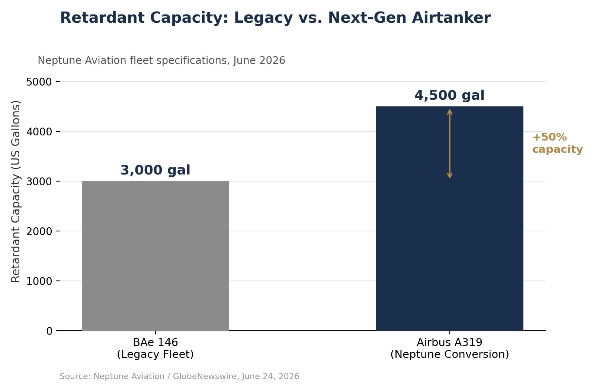
The A319 conversion carries a minimum 4,500-gallon retardant load, a 50% increase over the BAe 146’s 3,000-gallon ceiling.
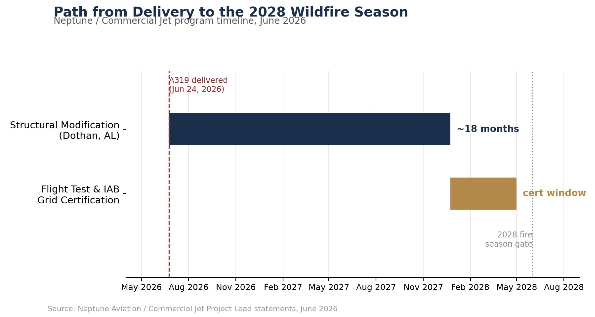
An 18-month structural modification window runs from the June 2026 delivery through late 2027, followed by flight test and Interagency Airtanker Board certification ahead of the 2028 season.
Sources
- GlobeNewswire, “Neptune Aviation Takes Delivery of First A319, Launching Next-Generation Airtanker Program,” June 24, 2026.
- AeroMorning.com, “Neptune Aviation shifts to Airbus A319 airtankers (2025–2026),” June 25, 2026.
- The Daily Utah Chronicle, “Bonneville fire blazes close to campus,” June 21, 2026.
- KSL.com / Deseret News, “Summer just started, and we already have 70 major wildfires in the US. What’s next?,” June 22, 2026.
- Forest Fire Management Victoria / State Aircraft Unit, “Innovation: Next Generation Large Air Tanker Services USA,” September 2012 (archival baseline).
- Nic Lynn, Vice President of Operations, Neptune Aviation, statement, June 24, 2026.
- Jennifer Draughon, President, Neptune Aviation, statement, June 24, 2026.